Showing posts with label Year 2. Show all posts

Monday, August 22, 2011

Coming To A (Korean) Tree Near You

Korean Adventure (November 15, 2002 Chautauqua)

A recent article in the Korea Herald (which used the above title) by Andrew Petty listed the major areas in the country where people could go to see the "most spectacular collections of autumn foliage."


There is Mt. Naejang in South Jeolla Province, Mt. Jiri and Mt. Gaya in South Gyeongsang Province, and Mt. Seorak in Gangwon Province. All feature rugged mountain scenery, splendid views of the trees, and a variety of Buddhist temples to compliment the serenity of a day in the wild.


Well, these areas are a bit removed from Daegu, so I had to settle for either Beisulsan (to the south) or Palgongsan (to the north).


I had been to Beisulsan last October, with a large group of friends. We caught a "coach bus" for a two-and-a-half hour trip that still wasn't over when we debarked. It seems the driver had let us off at the bottom of the hill, and it would be another three hour walk before we arrived at our condo.


There is nothing so resourceful as a group of foreigners to find alternate transportation. A truck driver at a nearby construction site was more than happy to carry us up the hill.


There was a short ten minute walk to our condo, which passed by a hillside temple surrounded by trees clothed in brilliant orange and red. The view down the valley was very nice. Trips like this exhaust your vocabulary. There is only so many ways to say it was all spectacular.


That night was spent consuming many beers, so that we would be in the proper frame of mind the next day. A long night of singing and drinking games is a fine way to appreciate the hike up to the top of the mountain.


There was a wide flat space just below the summit where a great congregation of trippers were enjoying picnic lunches and the view all the way around.

There was a pagoda on the lip of a precipice, and there were a couple of para-gliders to complete the picture.

Flint is enjoying this picture, I bet.

This year, I was all on my own. Saturday, November 2, was a brilliant day. The sun was shining, but the wind had picked up, and made the cold just a little more bitter.


I took a "coach bus" all the way from my place to Palgongsan. There is a small tourist village at the base, with a variety of restaurants, hotels, and souvenir stands.


Not being as physical as last year, I took the cable car to the top of the mountain. The trees were more colourful the closer I got to the summit. There is a much smaller space to move around, and there is a trail that leads back down.


I took this trail, but it is not for everyone. It is very rugged, with a lot of jagged rocks and tricky spots to negotiate. There are even ropes strung up to assist the more vertically challenged. Going up would definitely be a major challenge. Going down is no problem, as there is a variety of long stretches where you can do little else.


About an hour down from the summit is the temple of Dongwasa, which has the largest stone Buddha in the world. And it is enormous. It was erected in the hopes of the eventual reconciliation of North and South Korea (something a little more distant now that the North is going nuclear).


The temple itself is the center of a loose collection of temples, and there were many people using the various facilities to pay their respects. There is a large area at the base of the Buddha where you can light a candle. The floor of highly polished marble is a no-shoes area, and many supplicants brought their own rugs to pray in comfort.


Korea's "fall" is a very brief time between the steamy heat of summer and the bitter cold of winter. I was very happy to have taken advantage, and gotten a little taste of a world some only see in a postcard.

----------------------------------------
I have some photos of us strung out along the road, hitchiking, with our pant legs up to show our legs. Doesn't work too well on the guys. Another photo shows us all piled into the back of a Bongo, sitting on top of our bags. The guy was a good driver, and not one of us fell out on the way up.
I went to Dongwasa a few times. There's another temple/Buddha in the area at Gatbawi, which I never did manage to get to.

Friday, August 19, 2011

Inside Korea

Korean Adventure (November 1, 2002 Chautauqua)

I subscribe to an English-language newspaper called the Korea Herald. It gives mostly political and economic news, and a view of what some aspects of Korean life is like. There are profiles of Korean public figures, discussions of artistic endeavours, and bits of traditional lore/folkways.

In the political arena, one of the main points of interest for the past year has been the presidential election, due in December. There are two main parties, the Grand National Party, and the Millennium Democratic Party, which was created about six years ago by the sitting President, Kim Dae-jung.

President Kim received the Nobel Peace Prize in 2000 for his "Sunshine Policy" of reconciliation with North Korea. This process was stalled for a time after the election of George W. Bush, who included North Korea in his so-called "Axis of Evil." It is only recently that things have gotten back on track (pun intended). The two Koreas are building a rail link through the de-militarized zone, and working on a permanent re-unification village, where long-separated families can meet.

President Kim has had a very bad year. His administration is under investigation for corrupt practices, and two of his sons are now in jail for profiteering. The president is not eligible to run for re-election, but the voters are turning away from his party in droves. The present candidate has spent more time fighting off challenges from within his party than campaigning. Whether the party will survive to the election is still up in the air.

The candidate from the Grand National Party hasn't had an easy time, either. His son has been accused of draft-dodging, and there have been acrimonious exchanges when the law-makers meet in session. At one time, there were so many charges and counter-charges flying around, the Herald had a "Scandal Round-Up" section in the paper.

News from the north is scanty. There are tales of millions of people starving to death, which makes the need for reconciliation that much more acute. One story said that people were foraging in the hills for anything edible, and others were attempting to cultivate seaweed. The same day that story appeared, another one was printed that said the south's First Lady had sent up a shipment of soccer balls. The thought of starving people being given sporting equipment...

A recent article outlined South Korea's high costs and low quality of life. It is the eighth most expensive place to rent an apartment (three bedrooms): 1,580USD/month, as compared to: Taiwan 1,440USD; China 1,460USD; America 1,675USD; and Japan 2,160USD. Office space runs 523USD/year for one square meter (ninth highest), compared with 245USD in China, 452USD in America, and 486USD in Taiwan.

Korea ranks 22nd out of 131 countries in terms of living expenses, while Korean households earmark 4.9% of their budget for education of children, the highest ratio in the world, followed by the U.S., 2.4%; Japan, 2.1%; and Britain, 1.4%. Despite the high cost of living, the 2002 quality of life index for Korea stood at 5.64, ranking 32nd out of 49 countries and trailing Austria (9.77), the U.S. (8.92), and Japan (6.15). The hourly wage of Korea's manufacturing sector workers averaged 8.13USD as of 2000, ranking 21st of 29 countries and trailing Germany (22.29USD), Japan (22USD), and the U.S. (19.86USD).

A lot of Koreans drive their own cars, and they spend a lot of money customizing them to the particular owner's taste. They also have very good, and cheap, transit systems. I do not have a car, but I can get around the country very well for very little cost. It comes in handy when the freeways are jammed to zip past in comfort on the train.

Mostly everybody has a cell phone. It is not unusual to see a couple walking down the street, both of them talking away, but not to each other. The phones are cunning little items, and some of them have special headsets that make it look like wires are trailing out of someone's ears. A lot of people tap away at their hand sets, sending text messages. The rings are modern pop tunes/classical pieces that almost make up for it when they ring in the middle of a crowded movie theatre. Sometimes I think I'm the only person in Korea who doesn't own one. Even my kids have them!

I don't want this to be taken the wrong way, but sometimes Koreans remind me of big, happy children - easily mollified by bright, shiny objects - but with a capacity to work harder than we are used to in the west. They work hard, and they play even harder. They have the confidence that will surely be rewarded, and it will be more than deserved.
------------------------------------------------
I remember the GNP leader Lee Hoi-chang once being quoted that he was shocked, shocked, at the opposing parties' corrupt practices. The very next week he was under investigation, and he eventually retired from politics.
Despite it's very high standard of living, it was fairly economical to live in South Korea. Mostly because the school paying for your living expenses and health care.
I sometimes wish I was back there earning a living instead of begging for a job, any job back here in the world.
I didn't get a cell phone until my third year there. I probably should have gotten one earlier. I resisited as long as I could, but it just became too impractible not to have one.

Friday, August 12, 2011

Jinju

Korean Adventure (October 4, 2002 Chautauqua)

Jinju is a small (pop. 350,000) town to the southwest of Daegu. It is a very clean, pleasant place to visit. On the walk from the bus station, my friend G (who I met on the ferry to Japan) and I were offered sunny smiles from many of the school kids we saw.

The North Gate of the fortress.

The town is on the river Namgang, which makes a wide upside-down U through the town. Even though the summer season was over, there were a few people taking out the Duck Boats, and enjoying the breeze. There were some clouds that threatened, but held off until the evening.

Cannon-fired projectiles that probably really hurt.

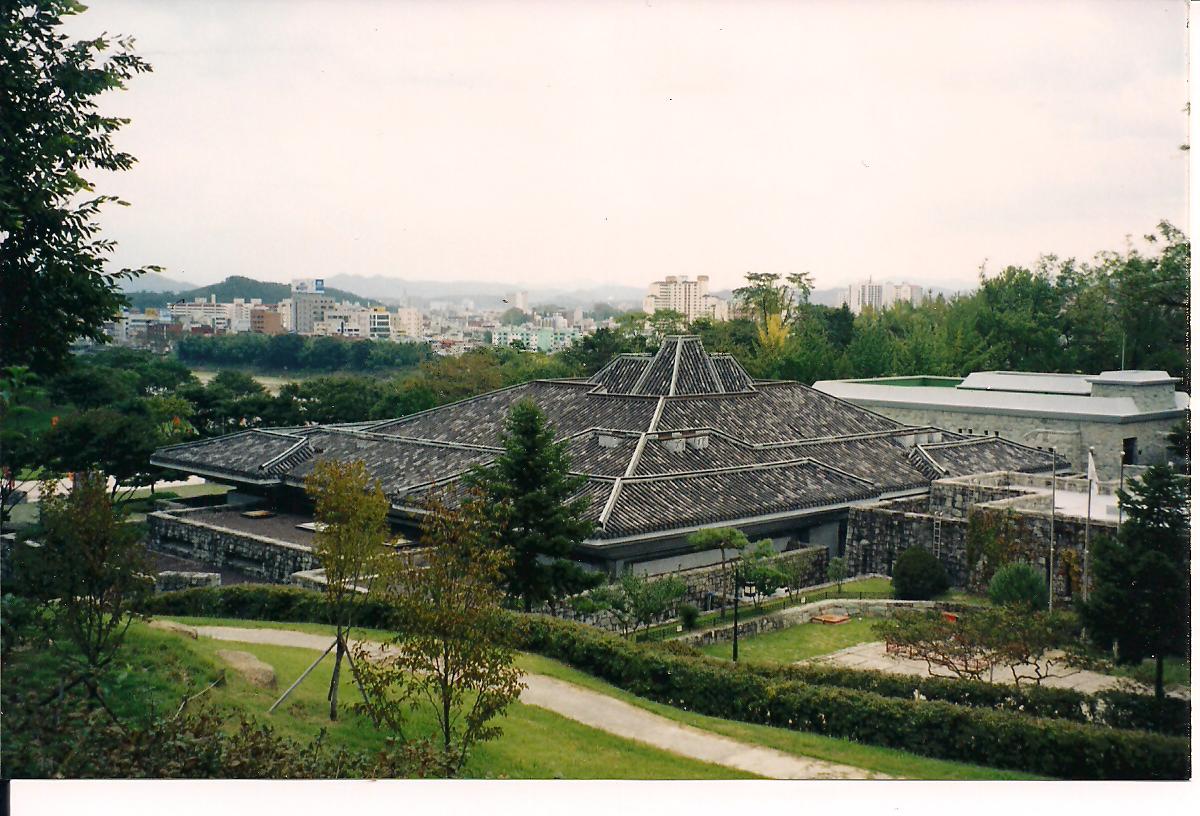
The main attraction in the town is the fortress Jinjusanseong. It covers a fairly large hillock on the north side of the river. Included on the grounds are a few Buddhist temples, as well as a National Museum.

The fortress walls, covered with ivy.

The walls of the fortress have been restored, and there are many paths to follow around to the various attractions.


The fortress was built during the years of the Goryeo dynasty (100 - 1000 AD), and partially destroyed during the Japanese invasion of 1592 - 1593. It was here that one of the major battles of the campaign was fought, in which some 70,000 Korean soldiers and civilians lost their lives. The wall was rebuilt in 1605, and these remains are there today. They look pretty good for 400 year old walls.

You see these crews all over the place. I used to think they were some kind of groundskeepers, but they're actually scrounging for greens to put on the supper table. See how they protect themselves from the sun.

Overlooking the river is Chokseongnu, a large pavilion which was used as an exhibition hall for the poetry of the times. It was burnt down during the Korean War.


The roof of the museum.
The museum devotes its exhibits to pieces detailing the period of the Japanese invasion. These include some pottery, and some impressive paintings and drawings. The detail on some of them is very intricate. There are also exhibits of poetry books, which look very old. Koreans have a good appreciation for poetry, and some are translated and printed in the English-language paper that I read (The Korean Herald).

The main exhibit was some detail of the invasion, and how the battles were fought. If you can imagine hordes of samurai, battling their way up and over castle walls, trying to avoid spears, arrows, and boiling oil, you might get some idea of what it was like. There is one mural showing the defense of the fortress. There are huge crowds of samurai surrounding a little fort with only a few defenders. I was reminded of Custer's Last Stand, or the Alamo.

The cemetary - these steles rest on turtles - good luck charms.

There is a memorial to the dead, and some statues of heroes from the battle.


General Li, who dies during the fighting, is posed with his finger pointing at the viewer, as if to say, "I want you!" The other hero is a woman, Madame Kim. She is revered for sacrificing her own life and killing the Japanese general. She lured him close to the river's edge, clasped him to her, and threw herself in. She locked her hands together with special rings, so that he could not escape her embrace.


There are some very old trees which date back to the invasion, as well. They are marked as being the sites for defense of the fortress. One was where General Li stood, and another shadows the spot where Madame Kim made her sacrifice.

Namgang Dam
After the fortress, G and I visited the dam above the city. There is a resort area there, but we were happy enough just to sit on the grass. Real grass is at a premium over here, and there are not too many areas where a person can just sit and enjoy the cool feeling.

Before we left, we enjoyed a meal in one of the many restaurants downtown. For a small town, Jinju has a lively restaurant/nightclub area.

A monolith up by the dam.

I got some of the facts for this article from the "Lonely Planet" guide to Korea. It is indispensable for the traveller. There are many useful tips, and good advice on how to get where you're going, and what to do (and eat) while you're there.

If you look closely, you can see a pillbox guarding the base at Jinju.
-----------------------------------------
Jinju was a pretty cool place to visit. At the time I went there, I only knew it as the place where the girlfriend of an American teacher I knew lived. He was a hound. He had two girlfriends, and it was a chore making sure neither knew about the other.
I returned to Jinju a few years later to see a live show. It was fairly popular in Korea, but I can't recall the name right now. It was about a family of martial artists who're visited by thieves one night. They each dispatch a thief with an amazing display of a particular aspect of the martial art.

Wednesday, August 10, 2011

Living In Korea

Korean Adventure (September 20, 2002 Chautauqua)

I'm going to try and reflect some facets of my life here, in the hopes that they may complete a picture, and show what I am experiencing.
I live in a one-room flat, in a three-story building. The other foreign teacher at my school has her apartment next door. Most schools provide the apartment rent-free, and all the teacher has to pay for is the utilities and the TV. As you walk in the door, there is a small area to leave your shoes. It is impolite to walk into a Korean house with your shoes on. I like to walk around in my slippers at home and at work. It is very comfortable.
I have a fridge, which is fairly large compared to other fridges I have known. Opposite is the sink/stove/cupboard area. It's all one unit, and that's my kitchen. I've gotten fairly good at preparing delicious meals on a two-burner gas range. It's pretty standard for most Korean households. Ovens are a rarity. Most Korean dishes are prepared without one.

One of the roads up to my con-apt, which was a block to the right. I did get a lot of what Flint calls 'Christers' visiting my con-apt. I was never as... curt as Flint was, but I did learn to shut the door on them after a while.

I have a TV/VCR unit, and I am limited to watching movies or whatever programs are part of the American Army's channel. They get most of the shows that are part of the lineup I was used to, but they can be some months behind. They have no paid advertising, but a lot of service announcements that let the soldiers know what's going on in their area. There are a lot of reminders about what it means to be a soldier. These are produced by the soldiers themselves, and some of them can be a little amateurish. I get a lot of laughs in this way.
The bathroom is a tiled room, with a toilet, a tap with showerhead attachment, and that's it. There's a drain in the middle of the floor, and that's where all the water drains. I've gotten used to washing my hands while standing back from the tap. It will be strange to return home and get used to water that drains "normally."

The street leading up to my building, which was on the right, the last building but one.

There are taps in my bathroom that would usually hook up to a washing machine. The other teacher has to deal with this, but my washer has been installed in the "back room," which is like a storage area. I have no dryer, and I take care of that job by hanging my clothes on a rack, which is standard issue for most teachers' apartments. Some buildings have a tap out front, and I have seen some Koreans using this to wash their dishes and their clothes.
I was really lucky to have a double bed in my place. Most flats have single beds (my first one did). Koreans, of course, sleep on the floor, and one of my friends (tired of the cramped and lumpy single) has switched to this with satisfactory results. I also scored a microwave, which comes in handy when I want to cook up some popcorn. That is one of the snacks that I really missed when I came here.

There were two busy streets that I had to cross on the way to work. North of this one was the neighbourhood where my con-apt was situated, which was mainly three-story one- and two-room buildings. South was full of those huge blocks that marched off into the distance.

Koreans don't usually eat popcorn. They have some... different...flavours for their chips, too. Some of them are really spicy, and can cause your tongue to dial the fire department if you're not careful. Some of their chips are sweet-tasting, as well. I remember a comedy sketch from a while back about a man who gave a snack bar attendant fits by asking for "Raspberry Ripple" flavored chips, and so on. He would have got on well here.
I live approximately fifteen minutes away from the school (by foot). There is a big hill behind the building, where I like to go hiking on the weekends. The trails are well maintained and travelled. Hiking is a favorite activity for many people, and there are camping areas that feature equipment for the serious hiker. You can do chin-ups, sit-ups, play badminton; there's even a set of barbells to do some press-ups.

This is the second busy road I had to cross. Right on the corner, almost at my feet as I took this picture, there was always a pile of tofu for sale. It sat on the corner every day, absorbing the exhaust fumes, burps and farts, narrowly missing being spat on by some mook. I... never really liked tofu after that.

The area I live in is predominantly three- and four-story apartment buildings. There are a couple of private dwellings, but these are scarcer than hen's teeth in a space-premium country like South Korea. I imagine you have to be wealthier than Croesus to afford a private dwelling. Surrounding the neighbourhood where I dwell, is the main living space for Koreans, the high rise, which go on for miles. I tried to get a picture that would show these buildings stretching to the horizon.
I pass through these on my way to work, and they are like little villages. The buildings are about 15-20 stories high, and about 10-15 apartments wide. They each have their own little strip malls, and "police" forces to keep an eye on traffic. There is a lot of foot traffic going through, mostly mothers with their kids in hand. Foreigners have a lot of eyes on them.

The building where my hagwon lurked. The PC room I used was across the street. The hagwon's name was New York, and the lobby featured a mural of the city skyline featuring the twin towers of the World Trade Centre front and centre. I worked here the year after 9/11, and it was always a little jarring to see that photo every day.

I've heard that this type of dwelling is more expensive than the one I live in. They don't seem much different inside, and I'm not sure I would want to live in an area so crowded, with people on either side, and on top as well as below you. You have to deal with a substantial loss of "personal space" when you come to Korea. There is no such thing as waiting patiently in line for anything. It's every man for himself, and don't be afraid to use those elbows.
Still, there are perks. I use a computer at a "PC Room," and the owners have gotten very good at arranging for a monitor away from the smokers. I get a nice comfy chair, and an iced tea. Being served in a restaurant is a pleasant experience, and you get a lot of "service" (free stuff!) if you become a regular.
And the beer! Ah, the beer. Their draft comes in inexpensive pitchers that always taste like another one. A night out with a group of teachers looking for a way to unwind can go on for a long time, with no appreciable dent made in your wallet. Most bars like to try and sell you a side dish to go along with your beer, and it's not unusual to see a table of Koreans enjoying a nice array of ... fruit?... to go with their beer. Or if that's not to your taste, you can always try the seaweed. Dip it into a little soy sauce. Mmmmm.
-----------------------------------------
I've had a couple of hagwons try to get away with just supplying me a beer fridge. They look at me strangely when I tell them I need a regular sized fridge. When you consider they have fridges just for kimchi, I don't think it too much to ask.
I remember in my first year, my roommate's girlfriend kept kimchi in the fridge, and whenever you opened the door, the smell would hit you like a punch in the face.
I was always impressed with the relentless way Koreans exercised. I was never able to get motivated enough to follow their example. I'm flabby and out of shape, and I would be of no use in a crisis. I thought, 'Either get in shape or hope there is never a crisis.' I always hoped there was never a crisis.
I remember going to one teacher's wedding. He invited me up to their con-apt. They were just moving in. The place was chock-a-block with all the newest appliances and electronics still in their boxes. It was too bad when she gave him the boot the day after the wedding, but he deserved it. He romanced a foreign teacher and then dumped her on the advice of a fortune teller.
What a douchebag.
I almost lived in one of those highrises during my third year, but was lucky enough to get a solo con-apt. For me, it's the only way to go.
I still didn't have a 'puter, and I didn't get one until my third year. The PC room I used in my second year was a pretty good one, and the owners were very nice to me. But having your own 'puter is the bomb. I was really happy when I got my first laptop.
This neighbourhood was in West Daegu, and the local bar we went to was called Elvis. More often than not, the waitress would insist we order a side with our pitcher. I got to like the dried squid with peanuts. You could dip the pieces of squid in mayonnaise, or hot sauce, or both. Mmmmmmmmmm.
But getting used to the side dishes that most Koreans took for granted was difficult for me. I missed the usual salty snacks that we get back here in The World. There were a few places that served popcorn, like the Hollywood Bar in Cheongju, but then you'd go to a place like The Berkeley in Daegu, which served squid-flavoured crisps.
Eurgh.

Tuesday, August 9, 2011

BodyWorlds

Korean Adventure (September 6, 2002 Chautauqua)

On August 2nd, I made a trip to Seoul. My main object was to do some shopping for books. Reading material (in English) is a little hard to come by, and I was gratified to find not one, but two bookstores that sold second-hand English language books. Both were in Itaewon, a district of Seoul that caters to international travellers, as well as soldiers from the adjacent American base.

The "69" Building in Seoul.

I bought 5 hardcovers and 7 paperbacks, which should keep me busy until next week. I was on my way to dinner when Whoops! Hey, there's a woman on my arm! How did that happen? Of course, I had seen her, eating noodles at a street kiosk. She must've thought I looked like a good mark, and she wanted to show me a place where the beer is cheap. I knew, however, that the drinks I would have to buy her would not be cheap, so I disentangled myself and went on my way. There is a "Hooker Hill" nearby, where the soldiers seem to go for that kind of "entertainment."

Seoul Tower. There is a smaller replica in Daegu. My first roommate went on and on about how much smaller it was, and then he would talk about how Texas had built a replica of the Washington Monument, except one foot taller. I think he had some sort of fixation with long, hard objects.

The other object of my visit to Seoul was to see the "Body World" exhibit at the Science Museum. This exhibit originated in Germany, and has begun its world tour here in the Far East. It features real bodies that have been donated to science and then specially treated with plastic so that they can be dissected, examined, and posed for research purposes. Somewhere along the line, it was decided to share them with the world.

The lineup for Bodyworlds...

There are bodies without skin, and some without muscles. There are some with only the organs, and some with just the blood vessels. The variety is almost endless, and they all offer a close up look at the inner workings of the body with real-life examples. There has been some controversy in Europe about this exhibit, and debate about whether someone's remains should be viewed in this manner.

... went down the block.

I myself was fascinated, but I did get some funny looks from some people when I tried to explain what I was going to see. It was quite a sight to see a person's muscles posed next to his bones, and to try and see in the mind how they would fit together. A few of the exhibits showed lungs that had come from smokers. The damage should be seen by all who smoke, and contemplate smoking.
Some of the bodies had been frozen, and then sliced thinly, both lengthwise and through the middle. The hanging pieces reminded me of what you might see in a slaughterhouse, except that these are people. I got a different perspective than I was used to, and it made me appreciate some things just a little bit more.

I was able to take one picture before being wrestled to the ground and beaten senseless. The figure in the foreground is of a chess player. The other figures are just garden variety gawkers. It's eerie how lifelike they are, isn't it?

The last part of the exhibit showed examples of the growth of the fetus. All stages of development were on display, from the almost microscopic one month fetus, to a fully developed nine month baby. There was even a fetus shown inside its mother's womb, inside the mother's body. A truly unique sight. I am not sure when this exhibit will be in North America, but I think everyone should be prepared to think about going to see it if it does.
An amusing aspect of my visit to the museum was that I felt sometimes that I was on display just as much as the bodies. It is a little funny to see some Koreans' reaction to the sight of a foreigner, especially the kids. Jaws dropping to the floor, eyes bugging out of the head, it just goes on and on. Sigh. Sometimes it’s tough to be a star. One thing that bothers me is being labelled "mi gook" (American). I always try to correct this misconception by saying "Anni-yo! Cho Canada saram!" (No! I am Canadian!). Koreans are impressed when you try to use their language, and are ready with pointers to help your pronunciation and comprehension improve.
----------------------------------
On my first trip to Itaewon, I was not too impressed after all I heard, and I didn't go back unless absolutely necessary. I had a hard time finding bookstores those first few years. My first roommate knew where they were, but he couldn't give you directions out of a paper bag.
You can see I was getting a bit tired of constantly being stared at when I was out in public. Even in Seoul. And it just went on all the time I was in Korea. You'd have thought they'd get used to foreigners at some point...

Sunday, August 7, 2011

Pusan

Korean Adventure (August 16, 2002 Chautauqua)

In my first year of teaching here in Korea, I spent the last six months at a school in the small coastal city of Changwon. I really enjoyed my time there as the school was well organized, and most of the people who worked there were really nice.

I went down to visit them on July 19th. It seemed like they were happy to see me, and we had a good visit, catching up on old times. It was interesting to see the kids that I used to teach in the morning were now attending in the afternoon. I guess they must have graduated from pre-school to elementary. It was kind of like watching my own kids grow up.

I was treated to dinner that night, to a meal advertised as a traditional Korean dish, galbi jjim. It was a great deal like my mother's beef stew, and I ate a pretty good portion. My old director picked up the tab, and he was even nice enough to treat me to a motel room that night. There are some very nice people down there.

The next day, I was off to Pusan, to visit a teacher I met on the ferry to Japan. My first stop was a motel, so I could drop off my stuff. An indispensable part of my journey here is the "Lonely Planet Guide." It gives some useful information about the country you're travelling in, including budget places to eat and stay. The motel I decided on was fairly cheap, with an...interesting atmosphere.

The bed was round. I think that might give you an idea of what sort of clientele the place catered to. There was even a vending machine in the room. The logo read: "Love Calling." Now, I am a world traveller, but sometimes I come across aspects of a foreign society that remind me that in many ways I am still a kid from the prairies.


My next stop was the ancient Geumjeongsanseong Fortress on top of a mountain. You get up there via cable car, which rises up through a sea of evergreens to a height of 540 metres. The contrast of forest and crowded city is startling, especially once you reach the top. It was almost like being back in the mountains of Banff National Park, it was that quiet. Fortunately it was a clear day, and I could see all the way to the port, and the Sea of Japan beyond.

The Busan World Cup Stadium. You can see how hazy it is. There were some clear days, but a lot of the weather looked like this.


There is not much left of the old fort, just some crumbling walls, almost hidden by the green growth of the forest. The gates have been restored and are impressive sites to see.


There are hiking trails that lead all around the outside of the remains, and it can take a day to see everything. A planned tour will end up at a magnificent Buddhist temple of Beomeosa.


I met my friend at Haeundae Beach, which is the most famous beach in Korea. There are international hotels, and many western-style eating and drinking establishments. My friend and I consumed many beers at a seaside beer garden, before going in to enjoy a curried dinner that just couldn't be beat.

There is one thing about travelling in Korea - it is fairly cheap and efficient. Buses, trains, and taxis are all well within the budget of anyone and everyone. There are even "standing room" tickets available for the trains, which are sometimes the only tickets available if you do not plan ahead. In no time at all, I was back "home," ready for the next trip.
------------------------------------------------
One of the teachers at my old school asked me why I came back for a visit. Her question was asked in an aggressive manner, like she suspected my motives.
Maybe she saw the unbridled lust I had for my old supervisor, I don't know.
When I was on the cable car going up the mountain, there was this ajumma who took a shine to me. Maybe it was my beard, or my Batman shirt, or my sheer animal magnetism.
Most Korean women have a hard time resisting.
When I visited my friend on haeundae Beach, he introduced me to Dongdongju, for which I will be forever grateful. As Flint always says, I love dong... dongju.

Thursday, July 28, 2011

Shopping In Korea

Korean Adventure (June 21, 2002 Chautauqua)

Shopping in Korea can be an interesting experience. There are many modern western-style supermarkets, including Wal-Mart, Costco, and Homeplus. It is a great temptation to stick to these convenient mega-stores. They carry most of the goods we are used to, and the prices are fairly reasonable. There are subtle differences, though.

The newly constructed (ca. 2008) Busan Fish Market

There is an entire aisle devoted to seaweed. It is dried and compressed into sheets of various sizes, from postage stamp to full human length. Koreans mainly use it to make "kimbap", which is like sushi. You lay out some seaweed, cover it with rice, and then various fillings like meat, fish, or vegetables. You then roll it up into a cylinder, approximately 12"long and 1" in diameter. Slice into pieces, and that is a meal. I enjoy having kimbap for lunch every once in a while. The price is more reasonable than the usual hamburger and fries, and it is filling, too.
There are also differences in the kinds of vegetables that are available. Koreans' favorite accompaniment to any (and every) meal is kimchi. It's a spicy cabbage. I’ve seen it made from a variety of vegetables, but the cabbage is my favorite. There is usually an island in the produce section where they make and display the various kimchis.

There is a lot of fresh fish available; any kind you could imagine, and some you could not. Squid and octopus are big sellers, and they are usually displayed live (in tanks) so you can be sure it's fresh.

Yes, the department stores are convenient, and have just about everything you could want, but the real "Korean Experience" demands that you go out and shop at the open air markets that are in every corner of the city. Some of them specialize in dry goods, furniture, food, what have you. There are some very good deals to be had, if you know where to look. A person can spend a whole day just wandering around, seeing the many sights and sounds. Buying something becomes a secondary consideration.


There are some interesting corners that some people might want to avoid. Really fresh meat and poultry in the form of caged ducks, chickens, and rabbits should not be confused with pet stores. I remember walking around the Chil-sung market (in Daegu) with my friends last summer. We rounded a corner deep inside the market, far from the main thoroughfare. There, laid out for display was a freshly slaughtered dog. How fresh do you ask? The muscles were still twitching.

Yes, the Koreans do eat dog. Some of the people I have talked to do not see anything wrong with it, and are nonplussed by some western reactions. There was even some talk of setting up dog-meat booths at the World Cup venues in order to introduce foreigners to this local delicacy. One foreigner, a teacher I believe, wrote a letter to the Korea Herald, denouncing this intention in a near-hysterical rage. I have not heard if the booths were set up. Maybe more PR-conscious heads intervened.

These open-air markets have been a staple of the Korean life-style for hundreds of years. Many of the structures look as if they have been there that long. People continue to flock to them, just as many go to the more modern establishments. This combination of the old and the new, makes for a fascinating experience for the traveller willing to explore beyond the beaten path.