Showing posts with label Japan. Show all posts

Monday, August 15, 2011

Go-Stop

Korean Adventure (October 18, 2002 Chautauqua)

"Go-stop" is a traditional Korean card game, usually played in smoky rooms with beer bottles and money scattered about. It is Korea's most popular gambling amusement.

The cards themselves come from a mixture of the deck used by the Portuguese sailors who sailed into these waters in the mid 16th century, and the deck that was in use in Japan at that time. Western-style card playing was made punishable by death in Japan in 1633, so changes were made in order to preserve the game that had arisen. The faces on the cards were changed to reflect Japanese culture, and the cards continued to be changed and modified as the years went by.
Japanese soldiers introduced their game, called "hanafuda," to Korea in the late 19th century. Koreans made some changes, and began calling the game "hwatu." The most popular game played using the cards today is "go-stop."
There are 48 thick cards in a deck with 12 different suits representing the 12 months of the year: January/pine, February/plum, March/cherry, April/black bush clover, May/orchid, June/peony, July/red bush clover, August/pampas grass and moon, September/chrysanthemum, October/maple leaf, November/paulownia, and December/willow and rain.

The first step to learning how to play is to study these cards, and recognize and match the colourful pictures. Two cards within each month are almost exactly the same. These can be called plain cards, equivalent to western junk cards.
The next step is to study the following cards: three blue ribbons with writing, three red ribbons with writing, four red ribbons with no writing, five with small round dots, three with pictures of birds, and eight with a potpourri of pictures: deer, pig, butterfly, insect, pillar, strange iris, chrysanthemum with soccer ball, and a pile of dung.
The rules state that three to five players are needed, with the action moving counter-clockwise. Deal out seven cards per person. Koreans have a very simple way of shuffling cards, and whenever I shuffle cards in the classroom (a very simple box shuffle that would be laughed at by any serious card player) I get "Oooh!" Aaaah!" and the occasional round of applause.

To continue, before placing the remaining cards facedown in a pile, flip over six cards in the middle of the playing area. Players take turns matching a picture in their hands with a picture on the floor. If they match, the player collects both cards and puts them in front of him face up. These are the cards that will score the player's points.
Before the player's turn is over, he gets to flip the top card on the deck and try to match that picture with the remaining pictures on the floor. Again, if they match, he collects both. If they do not, he leaves the card face up on the floor.
The strategy is to collect as many cards as possible, thus scoring more points. The goal is to collect enough cards to score three points. When this is achieved, say "stop" to end the hand. If, however, you want to gamble and double the money, say "go." The risk in doing this is that more points must be added during the next turn. If another player gets three points in the meantime, that player can stop the game and win. What is the penalty for your risk? You pay for the other player as well as your own loss.
The points are counted thus: three red ribbons/three points, three blue ribbons/three points, five birds/five points, three dots/three points, four dots/four points, five dots/fifteen points, 10 plain cards/one point (each extra plain card is worth one more point), one "go"/one point, two "go"/two points, and three "go"/double points.
There are a few interesting things to be said about the cards themselves. The blue and red ribbon cards represent old Japanese scrolls where poets penned their deepest thoughts and feelings.
The old man holding an umbrella in the December rain card is actually Ono No Toufuu, the founder of Japanese-style calligraphy. The August moon that sits atop a hill is nicknamed the "Buddhist monk." The single oldest card in existence today, made in the 16th century, is located in the Miike Museum in Omuta, Japan.
The novice should be aware of the professional player, who plays the game as a full-time job. There are stories of players who have lost cars, homes, and even wives! Some Korean families will not even allow the cards into their homes in strong disapproval.
I thought that playing the game would be an interesting way to bridge the language barrier with my students. However, the first time I took them into the classroom, I was handed a note by the Korean teacher. They believe it is a game for adults, and not for children. The feeling was that if the students even see the cards, let alone play the game, the school would be inundated by calls from outraged parents, calling for my head on a stake.
It was kind of embarrassing, but I guess that's all part of the experience of exploring new cultures.

I got most of the information from an article in "The Korea Herald," by Everett McGuinty, who is described as a "Contributing writer."
-----------------------------------
Once, when I took the ferry over to Japan, I saw a group of Korean men playing the game in one of the common rooms. I was sharing a beer with another teacher I had met (who was making his visa run) and we idly chatted as we watched the game. There was money scattered on the table, and it occasionally changed hands, so we imagined they were betting on the game.
A little later, some kind of crewmember passed by the table, took a look at what was going on, and said something to the players. They all looked like guilty little boys caught with their hands in the cookie jar as they tried to hide the money in their pockets.

Saturday, July 16, 2011

The Top Ten Ways To Amuse Yourself In Korea

Korean Adventurer (May 3, 2002 Chautauqua)

The Top 10 Ways to Amuse Yourself In Korea

This list was sent to me by my friend, Blondie. It provides some insights about what life in general is like over here.

10.) Play chicken with cars on the sidewalk. This is a fairly common occurrence. Koreans park just about anywhere they damn well please. Cars, motorcycles, and bikes take advantage of any opening anywhere, road or sidewalk, to beat the traffic. I remember walking home from the store the other night, and I heard an engine behind me. I was almost up to a space between two other parked vehicles, and I didn't bother moving aside, as I thought the space was too small for the following vehicle to pass through. I was startled to hear the motor continue close behind me. I looked, and was confronted with the smallest car I have ever seen. It gave new meaning to the word "compact".

9.)Order Steak and Potato with Fiddleheads at EVERY Korean restaurant. I'm not exactly sure what this means, as I've not had this particular delicacy. I think it makes reference to the fact that "fiddleheads" can make you sick if you're not careful. It's not really funny, as there was a story in the "Korean Herald" last week, saying that the food in six different fast food chains (KFC and McDonald's among them) had tested positive for staph infections in the foods. Bad news for westerners who do not like Korean food.

8.) While sitting in a public spot, pretend to catch a fly with chopsticks. Celebrate loudly. Koreans are intensely interested in everything we westerners do, and do not hesitate to stare when they so you. They also like to examine the contents of your shopping basket. It's nothing hostile, just innocent curiosity.

7.) When something is said by one Korean to another that is slightly amusing, laugh hysterically. Don't stop. Well, this is just plain mean. Hee hee hee.

6.) Stand outside a Korean electronics store where the TVs are playing. Pretend to understand every word. Again, just mean. The kids in my school get very excited when I display any knowledge of their language, and it is difficult to stop them from testing me, and turn the lesson back to learning English.

5.) Remind a Korean man that he is short. Do this repeatedly. Be prepared for an a** kicking. It's true that there are a lot of short people here, but they are also very thin. One of the first things that struck me when I returned home last year was how many obese people there were, myself included. Most Koreans like to get out and do some regular physical activity, for which they should be commended. Also, there are quite a few who are as tall, if not taller than some westerners.

4. Convince them that both of your parents are Korean (oh yes, it can be done). The trick to arguing with Koreans is to remain calm at all times. Once you lose your temper, you've lost the argument.

3.) Wear Japanese flags. The Koreans really are very touchy when it comes to anything Japanese. A person who makes a reference to the "Sea of Japan" will be provided with the correct title, the "East Sea". There has always been some tension in their relations. Last year it was some textbooks, approved for use in Japanese schools, that did not deal adequately with Japan's conquests and behaviour during it's Imperial phase. It only just got smoothed over when the Japanese premier paid a visit to the shrine for Japanese war dead. Some of those memorialized are considered war criminals over here, and the visit has cast a pall over the upcoming joint Japanese/Korean hosting of the World Cup.

2.) Go to the cinema. After the preview for a Korean film, pump your fists in the air and yell, "I CAN'T WAIT TO SEE THAT!". Actually, there have been some very good films made here recently. A few years back, a film called "JSA" won an Academy Award for best foreign film. It was a tense thriller about a South Korean soldier accused of murdering some North Korean counterparts. Another film, called "Friends", dealt with four rookie firemen that featured some thrilling firefighting scenes.

1.) Fix something. It always seems like there is something to be done when foreigners move into their (school-supplied) apartment. Usually, it's fairly simple to make it seem homey. My friends and I have managed to make our places comfy enough to be a close substitute for "home". We are convinced that we are the only ones to take the time and trouble. Some of the people we've had as room-mates have been less than...clean. Oh well, it takes all kinds, I guess.

Anyway, there is a lot more to tell about life in Korea. I hope I have not rambled on too long, and I hope you look forward to the next installment. Until then, anyong assayo (Peace be with you).
________________________________________

Ask Flint about the shopping basket thing, and then duck.
My description of the movie "Friends" is erroneous. It's actually about four Koreans who grew up in Busan. One became a cop and another became a criminal, with tragic results.
I remember helping Mick and Jane clean an apartment after another teacher had left. The filth was indescribable. I remember scrubbing layers of grime off of the tile in the bathroom and wondering how anyone could stand it.

Tuesday, April 19, 2011

Hello, Sailor!

One of the great things about teaching overseas is the chance to travel. I am a historian, and it was great to go and see things and places that I had read about and studied. Since Korea is bounded on three sides by water, there are many opportunities to travel by boat.
There are a lot of choices if you want to go to Japan. One of these is a hydrofoil that makes the trip from Busan to Fukuoka in a couple of hours. I preferred to take my time (and the hydrofoil was sold out), so I opted for the overnight ferry, the Camellia.

Busan Harbour

It was Chusok, and I had about a week off, so I was going to see Hiroshima. Travelling there would occupy two days. I would have three days to explore the city, and then a couple more to get back.

The ferry dock. The Camellia is the one in the middle, on the right.

The ship sails about six in the evening. The crossing takes about six or seven hours, and the ferry lies in the harbour at Fukuoka until the next morning, when it docks.

The ferry terminal in Fukuoka, from the deck of the Camellia.

Japanese Coast Guard vessel.

I had a basic ticket, which meant that I would sleep in an open area with most of the other people on board. The price of a cabin was prohibitive for such a short trip. You get a mat to lie on, a blanket, and a leather-covered block that's supposed to be a pillow.
There were a few other foreigners about, and I fell in with another guy making his visa run. Lucky to make the trip at Chusok, and on the ferry. I think he spent the balance of his time in Fukuoka while I was in Hiroshima, and I met him again on the return trip.
I don't remember a cafeteria as such. I think there was just a counter, where you could buy cup ramen or dried squid and kimchi. We drank a lot of beer from the vending machines. As we were headed to Japan we stuck to brands like Asahi and Kirin. Even though it was October, the weather was mild, so we spent most of our time up on the top deck, watching the moon set, and the lights of various fishing fleets that we passed through.
It was an amazing feeling to reflect that I was actually sailing across the Sea of Japan. (Even though I'd been in Korea for almost a year, I hadn't yet run across the term, "The East Sea.")
The Koreans occupied themselves with things drinking, talking, and playing games. One of the games they played was "Hwa-To," or Go-Stop, a card game that I very nearly learned how to play. I thought it might have been a way to bridge the gap between myself and my students, and I caused quite a stir when I tried to start a game in class one day. Apparently, go-stop is a betting game, and I was told parents would not be pleased to find out I was teaching their kids to gamble!
Anyway, it was fun to watch the Korean men playing the game. They really get into it. At one point, one of the ship's crew passed by, gave them the fish eye, and asked a question. It must have been about the gambling, because the players started to put the money away, all the while looking like little boys caught with their hands in the cookie jar.
I took this ferry on two different trips. The second time the weather was a little rougher, and you could feel the slow roll of the ship as it went through the swell. On one side of the ship, you were sheltered from the spray, but if you went to the other side, you were absolutely drenched. It's a good thing I had a change of clothes.
I didn't get seasick, but I could see some of the Koreans were green around the gills. There's a kind of patch they wear behind the ear that releases anti-seasickness medicine into the bloodstream.
I was on my way through Japan to Vladivostok in Russia. My thought was that I had come halfway around the world to Korea, so why not continue on in the same direction and so circumnavigate the globe?
And rather than just fly (like some mook), why not travel on the surface? Why not take the time to enjoy it? So I took the ferry to Japan, another ferry to Russia, and the Trans-Siberian Express to Moscow.

The ferry that I took was called the "M. Shokolov," and it traveled from the north coast of Japan, near the small port of Takaoka. It didn't sail until two or three days after I boarded, but I didn't care. I had finished my contract in Korea, and was kind of taking my time about getting home.


The crew loaded the ship with as many cars as it could possibly carry, even taking up all the available deck space.

Japanese don't drive on the right side of the road, so these cars had steering wheels on the opposite side I was used to. Russians do drive on the right side of the road, and it was interesting to see these were the majority of vehicles in Vladivostok.
I was travelling alone, so I did have some language barriers to cross. But the crew were helpful and courteous. The food in the restaurant was good. A lot of typical Russian dishes like borscht, served by the tallest, most beautiful blonde waitresses I have ever seen.
That trip took about three days. There was nothing but the ship, the sea, and the sky. My cabin was right on the waterline, which gave me quite the view.

Another ferry from Korea departs from Pohang to the island of Ulleongdo, which is just a hop and a skip from the Dokdo, where Koreans long to see the holy sites and meet the seagulls.

The Ulleongdo ferry docked after the trip.

This ferry is a kind of hydrofoil. The trip takes about three hours, and you're stuck inside for the trip. There's not a lot of open deck space. The seating is theatre-style, but my friends and I fell in with some English-speaking Koreans who helped us pass the time.
There are a lot of islands around Korea, besides Ulleongdo and Dokdo. There's also Jeju-do, which I visited with Flint. It was a good trip, but we didn't take the ferry there. We did, however, take a day trip around and about the southern coast.

If you go to the southern port of Tongyeong, you can get on a boat for a day trip to some of the islands in the area, one of which was the headquarters of Admiral Yi Sun-shin during the time he fought back the Japanese invasion of 1595. There's a re-creation of the place that he lived, and a channel marker in the shape of his famous "turtle boat."

One of the last trips I took in Korea was to the south-western island of Hongdo, Perhaps the last landfall before you reach China.
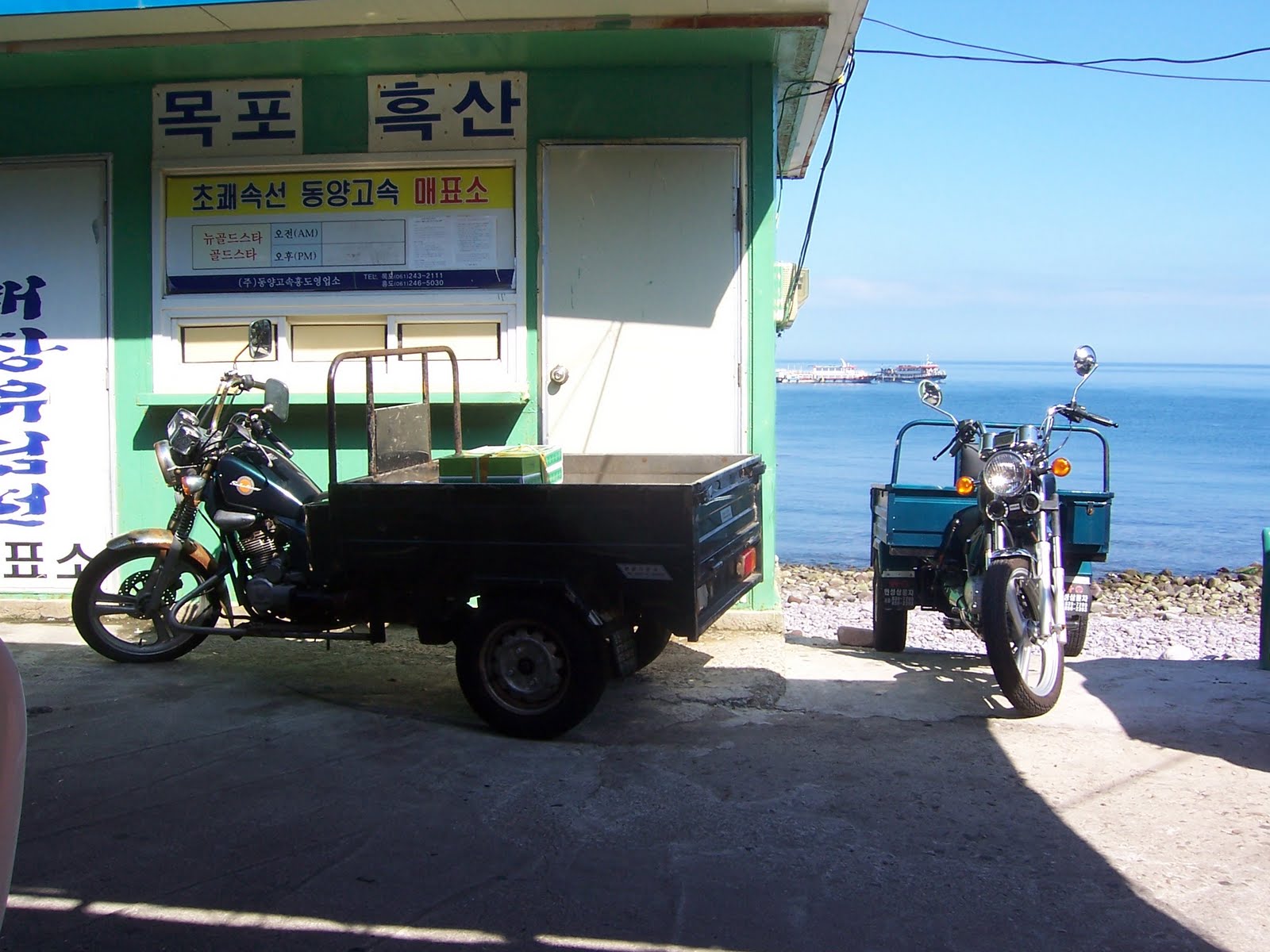
The ferry was another fast hydrofoil, with no opportunity to go out on deck. The island is so small that four-wheeled traffic is banned, and the islanders get around on motorcycles.
You're basically stuck with the main town, which occupies a neck of land in the centre of the island. The northern and southern areas are protected nature preserves.

There is a day trip around the island offered. It was interesting to see the protected area up close, as the captain took his ship as close to the island as possible at various points.


That day was very sunny on one side of the island, while the other was wrapped in cloud.
I neglected to wear sunblock, and got very burned. The trip ends with various fishing boats gathering around with fresh fish for sale. A lot of the Koreans took great styrofoam boxes home, packed with fish on ice.
But I think if you asked Flint or what our favourite boat was, I think we'd both agree on the "Casa Bianca," which is moored in Cheongju. The main floor houses one of the best rib joints we've ever tasted. Mmmmmmmmmmmmm.

Friday, March 4, 2011

Visa Runs

There are many ways to obtain the standard E-2 visa necessary to work as an English teacher in Korea. The Korean government has added many weird and wonderful prerequisites before they will allow you in. Some of the things they check out (drugs, HIV, perversion) are not asked of Koreans, of course, but regular readers will already be acquainted with my and Flint's rantings about this.
I received my education about the whole process the hard way. The first time I went to Korea, I went without a visa, and was stopped at the check-in at Vancouver.
A person can get a visa before they go to Korea, but I didn't know that. The recruiter neglected to mention the fact that I should keep my visa status on the q.t.
I did get to Korea and finally obtained my E-2 through what is known as the "visa run." My school sent me to Fukuoka in Japan, where South Korea has a consulate that handled the application.
There are a variety of ways to get to Fukuoka. There's an overnight ferry from Busan, as well as a hydrofoil that makes the trip before you can even blink. This time, I took the train to Busan, and a plane from Busan to Fukuoka. Daegu has an airport, but the reason why I just didn't fly from there was never properly explained to me.
My school paid for everything: train tickets, plane tickets, visa fee, and about $500 for expenses. Not bad. They even gave me a map of the city, so I'd know where to go.
It was a very interesting trip. I had to get up about 3 AM or some godawful hour (on a Thursday, returning Friday) in order to make the train. My doofus of a rommmate, who couldn't give directions out of a paper bag, didn't tell me that there were two train stations in Daegu. One was simply Daegu Station, while the other was Dongdaegu (East Daegu) Station.
Dongdaegu was fairly big, and not hard to miss, but thanks to my idiot roommate, I was looking for Daegu Station, which at that time was hidden behind an outdoor market. I wandered around, looking for the entrance to the station, being stared at by all the people getting their stalls ready.
I did find it, and I made my train. The ticket guy looked at me kind of strangely, no doubt wondering why I wasn't at Dondaegu.
Babo waegookin.
One of the things I loved about getting around Korea was riding on the train. They're fast, cheap, and relaxing. It was a nice easy glide down to Busan. Hmmmm, reminds me of Arlo Guthrie's "City Of New Orleans." Maybe Flint and I can adapt the words for Korea...
Anyway, I got to Busan, and even got off at the right station (Gupo). I had to take a city bus from there to the airport, and then made the short hop across the Tsushima Strait to Japan. History buffs will recognize this body of water as the place where the Imperial Japanese Navy took on the Russian Navy in 1905, and blasted it out of the water.
From Fukuoka Airport, I took the subway to a station near the Korean consulate. There was about a half-hour walk between them. After coming out of the subway, you see a foot-wide creek, which widens out as you follow it to the coast.

I arrived at the consulate about noonish, and submitted the necessary forms, photos, and fees. The visa would be ready for pick-up the next day, at which time I would reverse the trip I'd just taken.
I remember when I made a visa run to Osaka in '07 that the visa was ready the same day, but I still got a two-day trip out of it. Time enought to visit Osaka Castle even.

And I got a great picture of this neon bat sign from my hotel.

Sweet.
Fairly close to the consulate was the Fukuoka Dome, where the local baseball team, the Hawks, play.

There's a shopping mall and a hotel attached. The complex is called Hawks Town.

Just down the street is the Chinese consulate.

According to the map, Fukuoka is lousy with consulates, probably catering to thousands of teachers like me, getting visas for all the countries in the area. The ones I saw at the consulate were all doing the thing where they ignored everybody else, so I didn't have anybody to talk to at all during that trip. That's cool. I'm solitary by nature, and I don't feel right about inflicting my company on someone who doesn't care for it. Their loss.
As it was deep December, there wasn't a lot to do or see outside. I wandered down to the beach, but there wasn't a lot to see if you didn't like just staring at the ocean.

I did go on up the Fukuoka Tower, which is not as impressive as it looks or sounds. It's mainly an elevator and some observation decks.

But it does give you a nice view of the city and the bay.
There was an old fortress I wanted to see, but I ran out of time and money.

These photos are from a later trip.

I stayed at the Mimochi Twin Towers hotel. Very nice, and cheap, about $40 a night. I got to experience a Japanese bathroom, which was very economical about the space. Its shower was very similar to the showers in Korea. The spray hits you about mid-chest.
I ate at a Japanese version of a steakhouse (across from the hotel) and turned in fairly early. There wasn't much on the television for the English speaker.
But all in all it is an enjoyable trip, and a bit of a break from teaching, which at that time was torture for me and my poor students.
Japan is very different from Korea. The cleanliness is on a level far above Korea, and the people are polite. They don't stare, and they don't noisily clear their throats and then spit.
I made two, maybe three trips to Fukuoka for different E-2's, and another run to Osaka. The others I got in Canada before I went to Korea. Once I even went to Vancouver to submit the paperwork (I combined the trip with a visit to my sister).
After you get your visa, your hagwon can register you with the government, and arrange for things like your health care. I remember in my second year, the director's second in command Charlie, took me down to register me, and we got laughed out of the office. I had gone to Korea figuring I would do the visa run, but my recruiter and the school had expected me to come with the E-2 already in my passport.
SNAFU, eh?

Thursday, September 9, 2010

Undousuru anyone?

I saw a great way to learn Japanese on YouTube. The word of the day was undousuru which means exercise. After watching the video I had to do some private undousuru. It was better than the Japanese Learning English videos I have seen. :)

I wonder if a Korean version of Jwow is in the works? There was already a hilarious Korean version of 'Take Anything you Want" done. :)