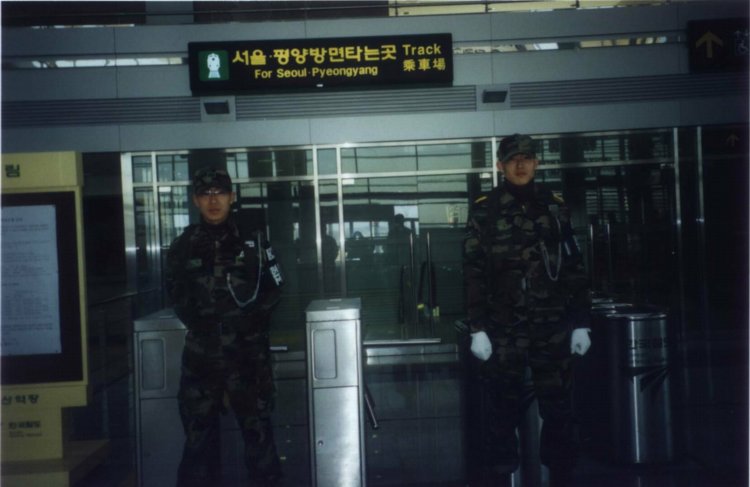
I found an old email that I had sent out to friends after the first trip I took to Panmunjeom. It was my second time in the DMZ. The first time I only went to the 3rd Tunnel and the train station. I went back to the DMZ with friends a year later and it took the 3 trips for me to see all of the DMZ "sights". When I started putting this post together it inspired me to do one about my 1st and 3rd trips as well. which meant this got put on hold until I finished the 1st and posted it.
The email consisted of some personal observations/stories plus information I copied from pamphlets and a web site.
Date: 6-May-03 12:15 AM
Howdy
Ah, a long weekend.
The plan was to go to Seoul 1st thing Saturday morning, take a tour of Panmunjeom in the afternoon, spend the night, and go back to Cheongju Sunday night. You know what they say about the best laid plans of mice and men. Thanks to sleeping in late (everyone not just me) we didn't meet up until it was close to time to leave on the tour.
I had hoped that JW could come with me, but there are some strange rules. It seems that South Koreans are ONLY allowed to the area with special permission. It takes about a month or so to receive, IF the government says yes. We can register online or by phone and go on the next tour. It seems very strange to be allowed into a part of a country where Nationals are not allowed.
We arrived for the tour registration on time. I was told that my shirt was not proper for the tour because it had a round collar. Which wasn't on their website under a list of restrictions. Most people on the tour were wearing stuff that they weren't supposed to. From shorts, to T-Shirts with stuff written on it. There was a chance anyone in "prohibited" clothes would not be allowed into the Joint Security Area (JSA). It is up to the soldier who is assigned to the tour. So, we leave Seoul with me wondering if I will not be allowed into the main area I want to see.
The drive out was much like the one on my first DMZ tour. Lots of traffic leaving Seoul, little to no traffic once you were by the DMZ. Around the DMZ there are several structures across the road that they call tank traps. When an invasion happens these things are blown up and block the road, for a little while. Basically they are like small bridges you drive under. They are made of concrete and stone, and the insides are filled with explosives. Makes ya feel safe driving under them. I hadn't realized that there were several of these structures ringing Seoul. Glad I don't drive around Seoul too much. ;)
There was a lecture on the history of Korea and the DMZ on the drive through Seoul and out. It only touched on the DMZ and JSA as our briefing at Camp Bonifas would cover it in more detail. We had to stop at the entrance to the DMZ so our passports could be checked. That went smoothly, and we were on to Camp Bonifas. It would be our last stop before Panmunjeom, and the site of a briefing on the history of the area.
Panmunjeom was a small village 48 km northwest of Seoul and 10 km east of Kaesong, located in the middle of what is now the Demilitarized Zone (DMZ). It was the venue of the Korean War armistice talks between the U.N. Forces and the Communists that lasted from October 1951 until July 1953. The 155-mile long DMZ established in Panmunjeom in 1953 at the time of the signing of the Armistice extends from Gyodong, Ganghwado Island (in the West Sea) to Myongho-ri, Gosong (in the East Sea). After the signing of the Armistice Agreement that ended the open hostilities on July 27, 1953, Panmunjeom was designated the headquarters of the Military Armistice Commission (MAC). Four levels of meetings are conducted between the two Koreas, and it has since been the guardian of the longest truce in modern times.
There are several structures in Panmujeom. Freedom House, originally built in 1965, was rebuilt in 1998. Panmun-gak, the administrative headquarters of the North Korean Security Force within the Joint Security Area (JSA), was built in 1968. Other buildings for inter-Korean dialogue were established in the 1980. In addition to serving as the stage for the MAC, it also acts as a meeting area for the conciliation, interaction, and cooperation between the two Koreas, with the cooperation part beginning to assume more importance. Panmunjeom also provides the only road connecting the two countries.
Liaison offices for both Koreas were established in Panmunjeom with 23 hotlines for inter-Korean dialogue and also a hotline at the MAC linking both Koreas. Panmunjeom is unique in that it is under the joint management of the United Nations Command (UNC) and North Korea. However, since the 1976 axe murder incident (in which North Korean guards attacked a UNC work party and killed two American officers), the sentries have been separated and the Joint Security Area split in half.

Two villages, one on each side of the DMZ, were authorized in a subsequent agreement to the Armistice. No other inhabited areas are allowed within the DMZ. Taesong-dong ("Great Success Village"), located approximately one-half kilometer southwest of the JSA, is in the UNC portion of the DMZ. The residents of Taesong-dong are required to be either original inhabitants or direct descendants of the villagers who were residing there when the Armistice was signed in 1953. Among other perks, male villagers are exempt from military service. However, villagers must also abide by strict rules, including a nightly curfew.
Directly across from Taesong-dong is the North Korean village of Kichong-dong or "Peace Village." U.N. troops call it "Propaganda Village" because of the propaganda often blasted from loud speakers located near the village. Although North Koreans work the fields by day, they are all removed from the area before dark and only a small custodial staff actually lives in Kichong-dong.
Also located in the JSA is the "Bridge of No Return." In 1953, this bridge was used to return prisoners of war of both sides, who were allowed to make a free irreversible choice on whether to return to their place of origin. For the North Korean and Chinese prisoners of war held by the UNC, this meant choosing between living in the South or Nationalist China (Taiwan), or being repatriated to North Korea or the People's Republic of China. Thousands chose not to return to their communist homelands.

The area has also been the site of a few high publicity crossings. This includes the 1968 repatriation of the crew of the U.S.S. Pueblo (captured in international waters 11 months earlier by the North Korean Navy), several defections on both sides, and the homecoming (and immediate arrest) of several South Koreans who visited North Korea without prior permission from the South Korean government. Recently, Panmunjeom has attracted more interest as a stage for peaceful unification.
According to the briefing we got the last violent crossing occured in 1984. A Russian tourist to the Northern side decided to defect. The North Koreans pursued him into the UN Command area and a firefight ensued. 3 North Koreans and 1 South Korean were killed, and several on both sides wounded.
The creator of Hyundai Motors, and Hyundai Group had one of the highest profile peaceful initiatives. Chung Ju-Yung was actually born in North Korea, and defected when he was a teenager. Unfortunately he had to leave his parents behind and was never able to aid or contact them after that. He always believed in helping unite the two Koreas. He helped to pay to erect a new bridge to connect the old Route 1 between the Koreas. In June 1998, he became the first businessman to cross Panmunjeom to North Korea to deliver 1001 cows.
The tension was palpable in the air as we entered the JSA. It is hard to express in words, it was just different. If you believe in it, my friend JW explained it best. You can feel the intensity of energy focused between the two sides. I can testify that you certainly felt something in the air.
First we went to Freedom House. It was a tad gaudy considering the history of the area. The gilded chandeliers in the entry hall seemed very out of place. We were told not to stop walking from the bus into the building. Although we could take pictures, we were told not to stop and do it. Once inside we were given the same restrictions for our walk into the blue conference building. We were also told that if the North Koreans entered the building we were to ignore them. Do not make gestures, touch, or talk to them.
Then we hiked across the road and entered the conference hall. We could see the talks table with all its paraphenelia. Of course we were warned not to touch it either. Two South Korean soldiers entered form the rear door, and two others followed us in. We were told that we were allowed anywhere in the room, including the part that is technically in North Korea. So, on Saturday May 3rd 2003, I entered and exited North Korea, and have pictures to prove it. ;)

I have to comment on the guards here. Talk about discipline. They stand in what is called a modified Tae Kwon Do stance. It is supposed to allow them to react even quicker to an attack, and to give an even more aggressive looking stance. They hold this stance for hours at a time. They do not move, you can't even see them breathe. While we were allowed to have our pictures taken with them, we were cautioned not to move behind them as they were authorized to deal harshly with anyone who moved in behind them. They just don't take any chances. Outside two guards always expose themselves in this stance looking down either side of the conference hall, while two others maintain the stance in a partially exposed area, to make it harder to shoot them. They watch the Northern side.

This stance is, well, unnerving. They seem like statues, but you can feel that they are ready to strike. The whole time I stood beside one of the guards I was nervous. I just kept expecting him to move or do something. The stance is definitely intimidating.
No North Koreans entered. (The North Koreans we saw this time looked anorexic.)
From there we went up to the observation pagoda which gave an excellent view of the area. One of the most beautiful gardens I have ever seen is in the JSA. It was the area were the firefight took place in 1984. We also had a great view of the North Korean area.
We left there to go to Observation point three. From there we could look down to the Bridge of No Return, see Propaganda village, and a couple of North Korean observation posts. We also had a good view into North Korea. As the officer was giving his briefing to us outside the OP I heard some explosions to the south, and could see black smoke pluming up. Several others saw it. When he was done his briefing I asked him about them. He hadn't heard the sounds, but said it could be land mines being exploded where they are removing them.
We reboarded the bus and begain the drive back to Camp Bonifas. Supper, a buffet, was served in the commisary, and was pretty good. We were also able to buy souvenirs before heading back to Seoul. All in all it was a very interesting tour.
Take care
Flint