Showing posts with label Museums. Show all posts

Friday, August 12, 2011

Jinju

Korean Adventure (October 4, 2002 Chautauqua)

Jinju is a small (pop. 350,000) town to the southwest of Daegu. It is a very clean, pleasant place to visit. On the walk from the bus station, my friend G (who I met on the ferry to Japan) and I were offered sunny smiles from many of the school kids we saw.

The North Gate of the fortress.

The town is on the river Namgang, which makes a wide upside-down U through the town. Even though the summer season was over, there were a few people taking out the Duck Boats, and enjoying the breeze. There were some clouds that threatened, but held off until the evening.

Cannon-fired projectiles that probably really hurt.

The main attraction in the town is the fortress Jinjusanseong. It covers a fairly large hillock on the north side of the river. Included on the grounds are a few Buddhist temples, as well as a National Museum.

The fortress walls, covered with ivy.

The walls of the fortress have been restored, and there are many paths to follow around to the various attractions.


The fortress was built during the years of the Goryeo dynasty (100 - 1000 AD), and partially destroyed during the Japanese invasion of 1592 - 1593. It was here that one of the major battles of the campaign was fought, in which some 70,000 Korean soldiers and civilians lost their lives. The wall was rebuilt in 1605, and these remains are there today. They look pretty good for 400 year old walls.

You see these crews all over the place. I used to think they were some kind of groundskeepers, but they're actually scrounging for greens to put on the supper table. See how they protect themselves from the sun.

Overlooking the river is Chokseongnu, a large pavilion which was used as an exhibition hall for the poetry of the times. It was burnt down during the Korean War.
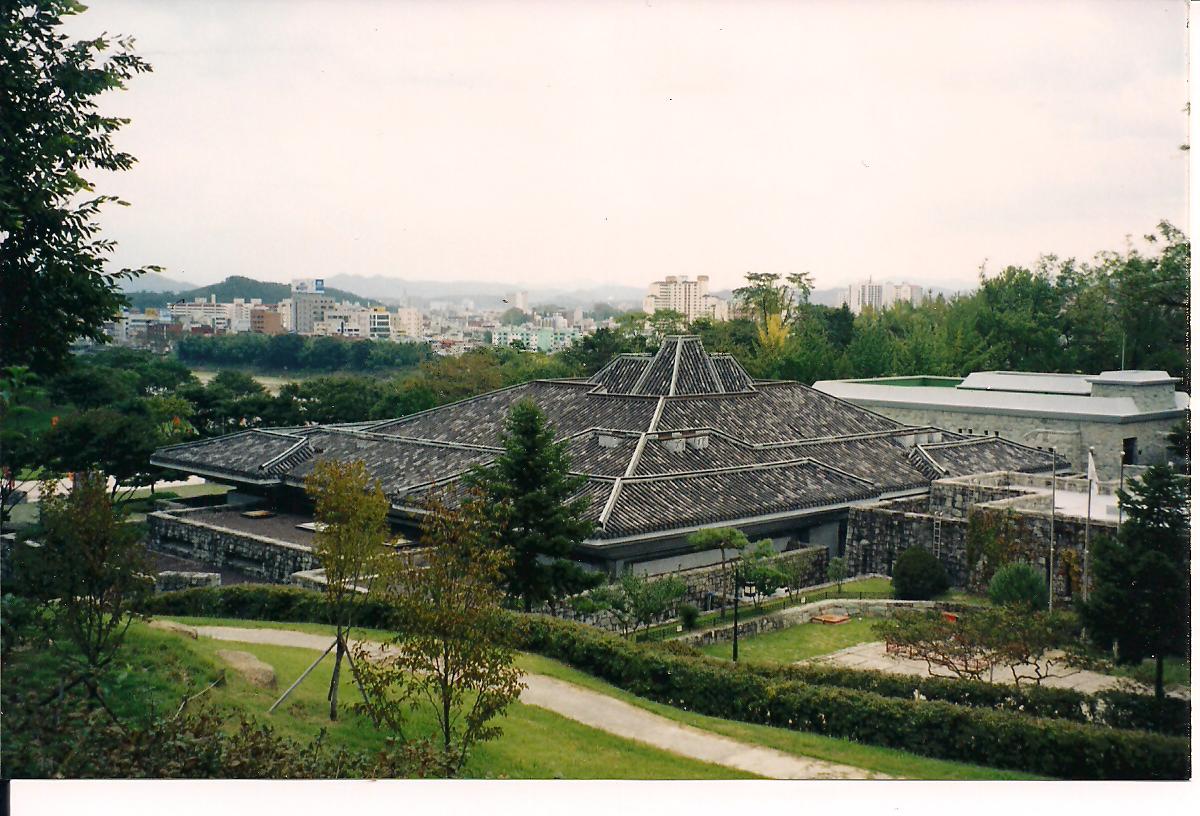

The roof of the museum.
The museum devotes its exhibits to pieces detailing the period of the Japanese invasion. These include some pottery, and some impressive paintings and drawings. The detail on some of them is very intricate. There are also exhibits of poetry books, which look very old. Koreans have a good appreciation for poetry, and some are translated and printed in the English-language paper that I read (The Korean Herald).

The main exhibit was some detail of the invasion, and how the battles were fought. If you can imagine hordes of samurai, battling their way up and over castle walls, trying to avoid spears, arrows, and boiling oil, you might get some idea of what it was like. There is one mural showing the defense of the fortress. There are huge crowds of samurai surrounding a little fort with only a few defenders. I was reminded of Custer's Last Stand, or the Alamo.

The cemetary - these steles rest on turtles - good luck charms.

There is a memorial to the dead, and some statues of heroes from the battle.


General Li, who dies during the fighting, is posed with his finger pointing at the viewer, as if to say, "I want you!" The other hero is a woman, Madame Kim. She is revered for sacrificing her own life and killing the Japanese general. She lured him close to the river's edge, clasped him to her, and threw herself in. She locked her hands together with special rings, so that he could not escape her embrace.


There are some very old trees which date back to the invasion, as well. They are marked as being the sites for defense of the fortress. One was where General Li stood, and another shadows the spot where Madame Kim made her sacrifice.

Namgang Dam
After the fortress, G and I visited the dam above the city. There is a resort area there, but we were happy enough just to sit on the grass. Real grass is at a premium over here, and there are not too many areas where a person can just sit and enjoy the cool feeling.

Before we left, we enjoyed a meal in one of the many restaurants downtown. For a small town, Jinju has a lively restaurant/nightclub area.

A monolith up by the dam.

I got some of the facts for this article from the "Lonely Planet" guide to Korea. It is indispensable for the traveller. There are many useful tips, and good advice on how to get where you're going, and what to do (and eat) while you're there.

If you look closely, you can see a pillbox guarding the base at Jinju.
-----------------------------------------
Jinju was a pretty cool place to visit. At the time I went there, I only knew it as the place where the girlfriend of an American teacher I knew lived. He was a hound. He had two girlfriends, and it was a chore making sure neither knew about the other.
I returned to Jinju a few years later to see a live show. It was fairly popular in Korea, but I can't recall the name right now. It was about a family of martial artists who're visited by thieves one night. They each dispatch a thief with an amazing display of a particular aspect of the martial art.

Tuesday, August 9, 2011

BodyWorlds

Korean Adventure (September 6, 2002 Chautauqua)

On August 2nd, I made a trip to Seoul. My main object was to do some shopping for books. Reading material (in English) is a little hard to come by, and I was gratified to find not one, but two bookstores that sold second-hand English language books. Both were in Itaewon, a district of Seoul that caters to international travellers, as well as soldiers from the adjacent American base.

The "69" Building in Seoul.

I bought 5 hardcovers and 7 paperbacks, which should keep me busy until next week. I was on my way to dinner when Whoops! Hey, there's a woman on my arm! How did that happen? Of course, I had seen her, eating noodles at a street kiosk. She must've thought I looked like a good mark, and she wanted to show me a place where the beer is cheap. I knew, however, that the drinks I would have to buy her would not be cheap, so I disentangled myself and went on my way. There is a "Hooker Hill" nearby, where the soldiers seem to go for that kind of "entertainment."

Seoul Tower. There is a smaller replica in Daegu. My first roommate went on and on about how much smaller it was, and then he would talk about how Texas had built a replica of the Washington Monument, except one foot taller. I think he had some sort of fixation with long, hard objects.

The other object of my visit to Seoul was to see the "Body World" exhibit at the Science Museum. This exhibit originated in Germany, and has begun its world tour here in the Far East. It features real bodies that have been donated to science and then specially treated with plastic so that they can be dissected, examined, and posed for research purposes. Somewhere along the line, it was decided to share them with the world.

The lineup for Bodyworlds...

There are bodies without skin, and some without muscles. There are some with only the organs, and some with just the blood vessels. The variety is almost endless, and they all offer a close up look at the inner workings of the body with real-life examples. There has been some controversy in Europe about this exhibit, and debate about whether someone's remains should be viewed in this manner.

... went down the block.

I myself was fascinated, but I did get some funny looks from some people when I tried to explain what I was going to see. It was quite a sight to see a person's muscles posed next to his bones, and to try and see in the mind how they would fit together. A few of the exhibits showed lungs that had come from smokers. The damage should be seen by all who smoke, and contemplate smoking.
Some of the bodies had been frozen, and then sliced thinly, both lengthwise and through the middle. The hanging pieces reminded me of what you might see in a slaughterhouse, except that these are people. I got a different perspective than I was used to, and it made me appreciate some things just a little bit more.

I was able to take one picture before being wrestled to the ground and beaten senseless. The figure in the foreground is of a chess player. The other figures are just garden variety gawkers. It's eerie how lifelike they are, isn't it?

The last part of the exhibit showed examples of the growth of the fetus. All stages of development were on display, from the almost microscopic one month fetus, to a fully developed nine month baby. There was even a fetus shown inside its mother's womb, inside the mother's body. A truly unique sight. I am not sure when this exhibit will be in North America, but I think everyone should be prepared to think about going to see it if it does.
An amusing aspect of my visit to the museum was that I felt sometimes that I was on display just as much as the bodies. It is a little funny to see some Koreans' reaction to the sight of a foreigner, especially the kids. Jaws dropping to the floor, eyes bugging out of the head, it just goes on and on. Sigh. Sometimes it’s tough to be a star. One thing that bothers me is being labelled "mi gook" (American). I always try to correct this misconception by saying "Anni-yo! Cho Canada saram!" (No! I am Canadian!). Koreans are impressed when you try to use their language, and are ready with pointers to help your pronunciation and comprehension improve.
----------------------------------
On my first trip to Itaewon, I was not too impressed after all I heard, and I didn't go back unless absolutely necessary. I had a hard time finding bookstores those first few years. My first roommate knew where they were, but he couldn't give you directions out of a paper bag.
You can see I was getting a bit tired of constantly being stared at when I was out in public. Even in Seoul. And it just went on all the time I was in Korea. You'd have thought they'd get used to foreigners at some point...

Sunday, March 28, 2010

Year 1 - Gongju

Howdy

I ended up going to Gongju yesterday instead of today. It was a fantastic trip. Min Jeong and I left around 9:45 AM and I got back just in time to make my 5:00 PM class. I had 2 minutes to spare. :)

The first place we went to was the tomb of King Muryeong who reigned ove the Baekje Kingdom from 501-523 AD. He was one of the last kings to rule from Gongju.

During the Japanese occupation of Korea most of the tombs in the area were looted of all their artifacts. As I mentioned previously, the vast majority of artifacts stolen by the Japanese are still in Japan today, and they do not intend to ever return them. Luckily for Korea the Japanese didn't find this tomb. No one did until 1971.

Workers were repairing damage done to tombs looted by the Japanese when archaeologists discovered King Muryeong's tomb. In it were the King and Queen, as well as a vast array of artifacts from the Baekje era. It is considered one of Korea's gtreatest archaeological finds. Hundreds of artifacts were recovered and many are on display at the National Museum in Gongju. The collection is actually the main focus of the museum.

The Gongju Historical site office is the first place you see. There is a brief explanation of the area, and a film, in both English and Korean. When you come back there is a beautiful gift shop, with some things you can only buy there. Mainly modern examles of Baekje crafts. There is some very nice stuff there.

It is a short walk up to the tomb area, actually a mound which several tombs are under. Before you get there you can see a replica of the tomb with some artifacts. The tomb itself was closed when we got there. They are working on it still.

The head of the area greeted us on our way in, and let us in for free after finding out I am Canadian. :) She also gave me a book on the area for free. It is in Korean and English, and usually has to be paid for. On the way out we stopped and talked with her for a while, and picked up some nic-nacs from the gift shop. I want to go back when I have more cash on hand.

From there we went to the Gongju National Museum. The museum opened in 1972, around artifacts found in King Muryeong's tomb. Part of it was built to resemble the inside of the tomb. Some of the artifacts you can see are the gold crowns of the King and Queen, gold, jade, and silver ornaments, pottery, statues, and weapons. One of the most interesting and amusing things I saw was the shoes of the King and Queen. They were made from metal and gilded. There were spikes on the bottom and toe area. They looked very uncomfortable, but would probably hurt like hell if you kicked someone.

There was also an exhibit to commemorate the last 10 years of excavations at Geumgang river. There were a lot of different artifacts from various eras there. From the stone, bronze, and iron age, as well as other eras in history. Also, there was an exhibit of paintings and photographs showing the changing face of Gongju, and historical sites, over the past 100 years.

Outside the museum is a garden area with various statues. There are many buddha statues, some without heads. Also guardian animal statues, pagodas, and huge water basins. They are all set out with English and Korean signs. All in all a very interesting museum, well laid out and presented.

After the museum we decided to head to the Buddhist Temple of Donghaksa. We had lunch before going to the temple at a place that serves Jung Shik. It was fabulous. For 7000 won each you get about 21 different dishes plus tea. (I treated.) There were about 5-6 different types of kimchi. Lots of veggies. A couple of fish dishes, 1 beef, and deonjeon chigae (bean curd stew). We were well fortified before tackling the walk to the temple.

It was a 2.5 km uphill hike from the parking lot to the temple. It is at the eastern end of the Gyerongsan (Gyerong Mountain) National Park. Gyerongsan literally means Rooster Dragon Mountain. Locals thought the mountain resembled a dragon with a roosters head. There are a couple of Temples around the park. Gapsa is one of the oldest Buddhist temples in Korea, and dates back to the unified Silla period, 8-10 AD. We will go there next time.

Donghaksa is a fairly large temple complex. There are quarters for monks as well as nuns. Plus the requisite worship areas. There is also a small shrine for followers of Shamanism. Buddhism didn't attack other religons when it came to Korea, it embraced them. Although not in the way Christian missionaries did, which was to co-opt and then destroy them. They set aside places for believers in Shamanism to worship in peace within the temple area.

The area around the temple is beautiful. The walk alone was worth the preice of admission to the park. You follow a winding lane which itself follows a stream that comes down from the mountains. All around are mountains. I want to go back in the fall, it will be even more beautiful when the leaves are changing colour. A very tranquil area.

You will find many cairns on the way up to the temple. As previously mentioned, people add to them and make a wish. Min Jeong and I both added to cairns.

We were both pretty tired after a long day, but we both had to get back to Cheongju to work. Traffic tried to mess us up, but luckily I made it back with enough time to run home, change and run to school. It was a great way to spend a day.

I should have pictures developed next week, along with those from Saturday's World Cup trip to Ulsan.

Take care,
Flint

*******

I miss hanging out with Min Jeong. She was a lot of fun. We had similar interests. Unfortunately she got married 5 years ago so no more male friends were allowed.

On a funny/strange note. Last night Stig and I were having a post-dinner cigar and drink on the benches when who do I see. Min Jeong. It was ... interesting to see her again. Her husband "lets" her out twice a week to walk. Those were her words not mine, and her English is still very good. So she was on her walk.

Do I expect to hear from her again, even though she "now" has my phone number? No. We exchanged pleasantries. I gave her my phone number which hasn't changed in 5 years. She didn't give me hers. She resumed her walk. Life goes on.